Showing posts with label Italy. Show all posts

Tuesday, May 8, 2012

Lido di Ostia

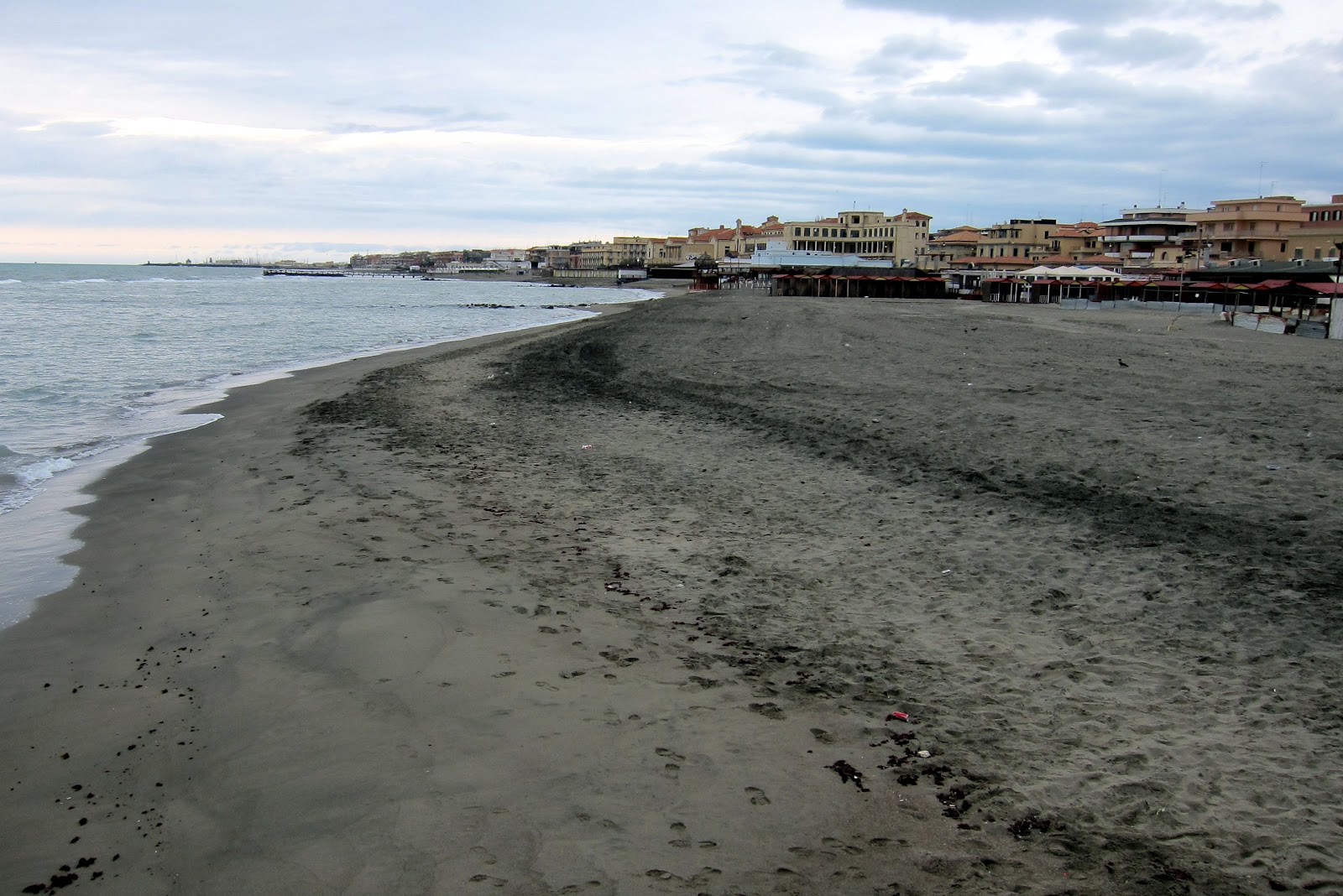
We spent our last night in Italy in Lido di Ostia, a resort town at the end of the line about 30 miles west of Rome, a metro ride from the Termini station and transfer to a train, maybe an hour’s trip total. The primary reason was that our hotel, the Belvedere Century, was near the airport (15 minute shuttle), so we wouldn’t have to wake early our last morning and hassle with luggage from the hotel to train station to airport. But Lido di Ostia is also a popular beach resort, apparently crowded during the summer months, and we thought there might be interesting restaurants and things to do there. But those assumptions did not turn out to be realized. For one thing it is a summer resort and we were there in April. It was essentially deserted. The beach was empty, the umbrellas and changing rooms shoved up in storage against the main road. A number of the hotels and restaurants looked to be closed for the season. Only a few locals, teenagers looking for something to do and older people looking for someone to talk with, ventured out on the outdoor mall across from our hotel. When we checked in, the desk clerk seemed bothered by our interruption of his surfing the net. As far as we could tell there were maybe five other rooms occupied for the night. We walked out on a pier from the beach, a few others huddled in coats in the wind and overcast, slate-gray sky. The whole feel was Coney Island in February. We wandered about and finally found a restaurant that turned out to be not that bad (though we were the only customers, perhaps of the whole night; the young waiter was more interested in the soccer game on the TV than on how we were doing). And ironically the hour we were to save by being close to the airport turned out not to exist. The shuttle left at 8:00 and 10:00, and we wanted to leave at 9:00 for an 11:30 plane. So we ended up having to take the 8:00, about the same time we would have had to leave a hotel in Rome had we stayed there, with the choice of restaurants, ruins, and streets to roam the night before. Instead of the hour from the Rome Termini to the airport, we spent the hour biding our time in the airport. One lives, one learns. . . . Well, one lives.

Wednesday, May 2, 2012

Eating the Amalfi Coast

It’s hard to eat poorly on the Amalfi Coast. Most of the osterias, trattarias, pizzarias, and ristorantes cater to tourists, but that doesn’t turn out to necessarily be a bad thing (as it can be elsewhere) as there are mostly tourists on the Amalfi Coast. Here’s our dining experience on our recent trip:

Amalfi

Pizzeria Donna Stella. On our first night in town we happened upon this wonderful place after discovering that Trattoria San Guiseppe’s, where I had eaten the first time in Amalfi (more in a moment), was closed for the day. We walked off the main street where most of the more touristy places are and wandered the maze of stair-streets before seeing a sign for Stella’s and decided to try it. There were only five other tables with diners in the small room – three with locals, one with a tourist couple (women from northern Europe?), and one with the young owners – a good sign. We shared a prosciutto and mushroom pizza and green salad, a carafe of house red wine, and a cream and blueberry dessert. It was all excellent.

Trattoria San Guiseppe’s. For lunch the next day we returned to this restaurant, one of my favorite from my trip several years ago. We shared a la Genovese pizza – tomato, mozzarella, tuna, and olives – just as good as I recalled, with a wonderfully caramelized thin crust. There were only two other tables, one with a large group of locals, the other a tourist family.

Ristorante Pizzaria Il Mulino. We had passed this restaurant on the upper end of the main street while visiting the Paper Museum, and while there was only one other table with one couple (tourists; and another tourist couple arrived after us), we decided it looked worth trying (by then we’d realized that most of the restaurants catered to tourists). And it was. We shared a mista de mare antipasta, Jac had a fresh spaghetti with vegetable sauce and cheese dish, and I had gnocchi with a tomato and cheese sauce. All accompanied by a Ravello wine (A. Sammarco rosso). Once again, all very good.

Ristorante Vittoria. The next morning we took the bus up to Ravello, did the spectacular Villa Cimbrone and Villa Rufolo and the Duomo di Ravello, and then searched the map we’d gotten at the Tourist Information office for a restaurant, and settled on the Ristorante Vittoria, near the piazza duomo, where we were. It was a bit unsettling to see the only tables in the place were two groups of loud Germans. But they left soon after we arrived. As we sat there, though, we were encouraged to see a number of apparently nearby shop owners or workers coming in to get take-out boxes. Jac had a pasta (fresh noodles) with clam sauce that was excellent, and I had catch-of-the-day fried seafood, a mix of shrimp, calamari, and three small whole fish, and a mixed salad, all very good. And we lingered over a carafe of the house white wine. A good meal, and good to sit for an hour after several hours of a lot of walking and another couple of hours of more walking as we hiked down the path from Ravello to Amalfi.

Il Tari. We’d passed this restaurant the past two nights and seen that it was nearly full, so we decided to try it on our last night in Amalfi, a Saturday night, and it was crowded with both tourists and locals. And again it turned out to very good: Jac had chicken picata, and I had a fixed price menu of antipasta (ham, mozzarella, tomato, and olives), chicken picata and salad, and pound cake with a lemon-cream sauce. And a shared carafe of house white. A nice last meal in Amalfi.

Positano

La Zagara. After a crowded bus ride from Amalfi to Positano, a long, confusing walk down a lot of steps to our hotel, checking in, walking down to Fornillo Beach, over to the main part of the town, wandering the step-streets, we decide to duck into this café for lunch. It’s the dining mistake of the trip. We only learn later that it’s mainly a pastry place (and I guess a good one), but we head out onto the patio and order a pizzeta (Jac) and calzone (me). Neither is very good (and Jac gets something she didn’t order). But it’s an hour rest before more walking.

Hotel Pupetto. Our hotel, the Hotel Vittoria, shares this restaurant, located on Fornillo Beach, and since we got a 15% discount, we decided to make this our first dinner in Positano. And the restaurant is right on the beach, a hundred or so feet from the water. The waves were our background music (although the kids running around added their layer). As the sun set, a bat flew over our table, gorging on insects. A cat begged for food. Jac had spaghetti carbanara, and I had a fixed price meal of risotto and veal scaloppini, and we shared a carafe of house wine. It wasn’t the best meal of the trip, but it was good – and the total cost was only €40 (€10 for Jac, €20 for me, and €10 for wine).

Ristorante Saraceno d’Ora. After wandering around Positano most of the morning and into the afternoon, we decided to walk back up toward our hotel where we saw a number of restaurants earlier on the road above the hotel. Walking on the street, a waiter at this restaurant (as is common throughout the town) begs us in, and while looking at the menu we hear a couple of tables of locals inside and decide to try it. It turns out to be one of the best meals of the trip. We ordered a four cheese (quarto formaggio) pizza, water and beer, and all – pizza, drink, and service – was excellent. We only learn later it’s the #5 of 52 restaurants in Positano on TripAdvisor. We were offered complimentary limoncellos as digestives.

Ristorante Mediterraneo. We could see this restaurant on the road above our hotel from the balcony and hear the music playing from across the way. I read about it prior to our trip (rated #7 on TripAdvisor), and we’d stopped by to look at the menu in the afternoon before having lunch at nearby Saraceno d’Ora. This was a great last meal on the Amalfi Coast. We started with two antipastas, a plate of prosciutto, salami, sardines, olives, stuffed zucchini flowers, and a separate plate of zucchini flowers; Jac had fried calamari; I had a rigatoni Bolognese; and we split a carafe of house red wine. More than we could eat, but maybe the best meal of the trip. An Aussie couple sat behind us after we’d been served, asked us about our dishes, and ended up ordering what we’d ordered.

Lido

La Sireinta (can’t find an internet link). We spent our final night in Lido, out in East Rome on the beach, a resort which is basically deserted in April, cold, windy, and gray. But we did so so we could just hop a shuttle to the airport in the morning, and in that it turned out OK. We walked around the area in the evening looking for someplace to eat, but there weren’t too many places that looked good (or open). But La Sirenita held some promise (it had carbanara on the menu, which is what I wanted on my last night). We were the only ones in the small, contemporary room. One young waiter balanced his time between us and a soccer game that was playing loudly on a TV. Jac ordered a fettuccini funghi porcini, I ordered insalada de mare and pasta carbanara, and we shared a carafe of house white. And all was very good. We paid in cash, and the owner apologized to us as the waiter had to run off somewhere to get change as we apparently were the only customers of the evening and they didn’t have any.

Sunday, April 29, 2012

Il Ventilator

I’ve always been a light sleeper. For years I’ve had to sleep with the ambient noise of a fan when I could. (I keep a small fan in my car for when I’m on the road.) If I don’t have a fan, I have earplugs to help keep the noise out. When I went to Italy several years ago, I stayed in three different hotels that had air conditioning, it was in June, and the fans from the air conditioners worked fine as ambient noise. But one hotel, on the island of Procida, didn’t have air conditioning. When I checked in, I asked the receptionist if they had a fan I could use, but she didn’t speak any English, and I had to go through various linguistic gyrations, followed by a crude drawing of a fan on a bar napkin, to get her to understand what I was trying to ask for, but she didn’t seem to think they had whatever it was I was wanting. But when I returned from my walk around the island that afternoon, she flagged me down as I was going to my room and presented me with a black metal fan from what must have been from the Mussolini days. But it worked fine, and I considered the whole interaction a success in multicultural understanding. And I slept quite well for the three nights I was there.

On our most recent trip to Italy, on our first evening in Amalfi, I asked the manager of the hotel (Lidomare) if they had a fan – I’d learned that the Italian was il ventilator, but I still had to draw a picture on a scrap of paper. He told me – this was not in any coherent conversation but rather a staccato of Italian/English from him and English/Italian from me – that they didn’t have one but there was a heater in the room that they could turn on. I didn’t want a heater (it only was in the 50s overnight) and told him that all was fine. I slept well that night with my earplugs. As we were leaving the next morning, he stopped me to say that he was having the house keeper try to find a fan he thought they might have, but it had been stashed away somewhere where no one could remember. But when we returned that afternoon, there in our room was a floor fan. And it was not from the Mussolini days. In fact, it had not a scratch or speck of dust on it. It had not been stuffed in the back of some closet. I have no doubt that he had had someone go out (or did so himself) and buy a new fan. Not necessarily just for me. Perhaps he had thought, Maybe we should have a fan for such a situation. But this was clearly a brand new fan.

You hear about indifference, if not surliness, between Italians and tourists, particularly American tourists. That’s certainly not been my experience. If it exists, perhaps it’s because of the tourists and not the Italians. My experience has been of cheerful accommodation over and beyond what I might have expected. And I would like to think that part of that is because I don’t present myself as the demanding, entitled American (which I have seen too often), but rather as a pitiful lost soul, stranded on a lonely shore, in need only of il ventilator.

Saturday, April 28, 2012

Positano Mistake


Sometimes making a mistake can be a good thing. On our first afternoon in Positano, we walked from our hotel, in the west part of the town, down the stair/street to Fornillo Beach, across a path over the bend in the coast, past a 13th century lookout fort, and into the main part of Positano. We walked through the narrow streets, the piazzas, shops, restaurants. In the late afternoon, we decided to catch the little red bus that winds through the only street in the town that allows traffic back to the hotel. The main stop is at the Piazza dei Mulini (the closest motor vehicles can get to the lower town and beach), and we bought our tickets at a tobacco shop across from the stop and only had a short wait for the next bus. What we didn’t know is that there are two red bus lines. One, the Interno Positano route, stays in the town, looping through both the east and west parts. The other route, Termini, goes along the main Amalfi Coast road for a short way, and then turns up and climbs up and up and up to the small town of Nocelle, 400 feet above Positano. Our mistake was getting on the latter bus. The road is one-lane, two-directions, winding up the mountain. But while it’s even narrower in most places than the main Amalfi Coast road (hard as that is to believe), there isn’t much traffic, so the anxiety is replaced by the awe of the ever-new vistas that open up around each turn, high above Positano and looking out across the sea. This was the good fortune of our mistake – the reward of a dizzying scenic ride, one of the highlights of our trip. If only more mistakes could be so rewarding.

Thursday, April 26, 2012

The Surprise of Travel


One of pleasures of travel is surprise, particularly the surprise that rewards a seeming setback or hitch in plans. Our plan (recommended to us by guidebooks and the Tourist Information office) was to take the bus from Positano to Sorrento, take a short bus ride up from the dock to the train station, catch the Circumvisuviana local train to Naples, and from there transfer to a national train from Naples to Rome. But the morning of our trip, the receptionist at the hotel told us that there had been a rock slide and the road between Positano and Sorrento was closed. But she recommended we take a ferry (leaving Positano in an hour) to Salerno (stopping briefly in Amalfi), and then walk the short distance to the train station in Salerno and catch a direct train from there to Rome. And that turned out to be the way we should have gone from the outset. Of course, up until the day before, the ferries hadn’t been running along the Amalfi Coast because of rain, wind, and waves, though none of which had affected us much on shore. But this morning the weather was perfect: calm sea, blue sky, 70°. We pulled away from Positano to a marvelous view of the town, and the hour-plus ride was a constant trail of one sight after another along the rock-ribbed cliffs of the coast. I can’t imagine – no, I’m sure – that the bus ride, train ride from Positano to Naples couldn’t have touched the ferry to Salerno. The pleasure of surprise in travel.

Thursday, April 19, 2012

Idiot In A Strange Land

I was the witless victim of a scam in the Rome train station. Having nothing else to do, we had sat in our seats 45 minutes before our train to Salerno was to leave, and as soon as my wife had gone to the restroom, the guy came out of nowhere (as is their wont), looking like a homeless man with a faux badge – dirty jeans, T-shirt, oily disheveled hair . . . and a laminated badge with picture of someone on it pinned to his chest. He sat down opposite me, the only other person in the car, and asked for my ticket, which I gave to him. He had a laminated badge. In Italian (which I neither speak nor understand) he says that I need to pay an additional €20 as a fee for going from Naples (one stop for the train) to Salerno (the next). I point out that I’ve already paid for the tickets to go to Salerno, but he has a ragged book with figures he’s written in, and asks me to write my name and destination and €20 to his list in his book. I protest slightly, but finally just give him his (formerly my) €20. He leaves, and I already know I’ve been had.

He obviously had me tagged as an easy mark as we were getting on the train, and waited on my wife to leave to get one-on-one with me, the only one in the car. If there would have been anyone else around, they would have no doubt spoken up against the scam. If the transaction would have been in English (or if I were fluent in Italian), it would have been very different:  “You need to pay me an additional €20 fee to go to Salerno.” “Who are you? And no I don’t.” “Yes, you do, look at my laminated badge and ragged book.” “Why don’t we find the conductor, who, if there were such a fee, would be the one to collect it?” But I don’t speak Italian, and so was intimidated, an idiot confronted by an ill-dressed con artist. As I handed over the €20 bill, I was telling myself, “You deserve to lose this, you dumb asshole.” There is, at least, some comfort in being a knowing fool.

Saturday, April 14, 2012

Parla inglese?


In preparation for a trip to Italy’s Amalfi coast, I’ve been spending some time trying to learn the basics of the language, as least to be able to say “I don’t speak Italian” (Non parlo italiano) and “Do you speak English?” (Parla inglese?). On previous trips to Italy, these are the two phrases that have been the most useful, and I’ve picked them up again fairly quickly, though I wouldn’t say fluently. I’m sure whatever utterance I spit out attempting those two phrases will convey the idea that I don’t speak Italian and I hope the listener speaks at least a rudimentary English. And the fact that I make the effort to say I don’t speak Italian in Italian (however ironic) at least shows a sense of respect to those I’m imposing on.

But I’ve also been trying to go beyond expressing my obvious inability to speak or understand Italian. I’m sure it would be magnanimous of me to ask for directions in the language of the natives (Dov’e la stazione? or Come ci si arriva?), or order at a restaurant (Sono pronto perordinare or Vorrei una bottiglia di vino rosso), or navigate public transportation (Quest autobus va a Ravello? or Penso di essermi perso). But what if such conversation starters result in conversations? I’d be lost after my initial query or request, not understanding directions or costs or follow-up questions and immediately have to retreat to my stand-by, Non parlo italiano, no doubt to be met with the disconcerted Allora perche diavolo l’hai detto in italiano? No, it’s probably best to just begin with Parla inglese? And if the answer is Non, there’s always mumbling and pointing. That works surprisingly often.

Wednesday, November 30, 2011

A Good Airfare

The Amalfi Coast has been toward the top of our travel list since at least six years ago when I escorted a group of college students to Italy and spent several days in Amalfi (I only got the students to and from the airport in Rome; I was on my own for the rest of two weeks). The next year my wife and I traveled to Italy, mainly because she hadn’t been able to go with me the year before, but we only had ten days there and I (having been three times before) decided that Rome (the Forum, Vatican, Borghese Gallery) and Florence (the Uffizzi, Ponte Vecchio, David) were probably numbers one and two on the list of Italian cities in terms of history and art. But the Amalfi Coast is one of the most beautiful places I’ve ever been, so it’s lingered near the top of our list.

So for the past several months I’ve been monitoring airfares to Rome or Naples, hoping to catch a slip in cost that would give us an advantage. And last week I hit on a rate at least $200 less per ticket on American Airlines (our preferred) than what I had been finding, and we bought it.

Just yesterday, though, American filed for bankruptcy. Curious as to how this might affect our Amalfi trip, I followed all the news stories I could find, and was comforted to learn that the bankruptcy would not disrupt flight schedules or frequent flier miles. But I wondered how airfares might have been affected, so I checked into the American online reservation site and was pleased (though not surprised) to find that the cost of our itinerary had almost doubled, from $1750 to $2500 (two fares plus taxes and fees). 

It’s an interesting pleasure. Part is the satisfaction of having regularly monitored airfares to finally find a decent fare (less actually than when I first went six years ago), and part in seeing that fare balloon up in just the next few days. No doubt I’ll be drilling all of those poor souls around us on the plane about how much their tickets cost. Or perhaps that might not be such a good idea. It might be best to just keep quiet and gloat in silence while I watch the in-flight movie.

Sunday, November 7, 2010

Collapse of "The House of Gladiators"

The “House of Gladiators,” a prominent ruin in Pompeii, collapsed Saturday (before the site was opened to the public), and politicians, archeologists, and the press are complaining about the lack of upkeep on the part of the Italian government of the 2000-year-old site. Those complaints may well be grounded, but I think they miss the point. Preservation is all well and good, and I’m certainly for it. I’ve been to Pompeii twice and came away both times (once on the wrong train) with a sense of awe and reflection (and a sunburn and immediate need for a cold Peroni). My Lonely Planet guidebook said to imagine all the hordes of people being the inhabitants of Pompeii, going about their business in the crowded port city back then. But I couldn’t do that. Perhaps it’s a personal defect in my imagination, but I couldn’t get past that these were ruins — crumbling red brick walls of buildings with no surviving roofs, furniture, utensils — not to mention that my interior evocation could not turn the roaming bands of mostly German and Japanese tour groups into a bustling mélange of togaed Romans.

The real problem with historical sites like Pompeii is the conflict between preservation and promotion. Some 2.5 million people trek to Pompeii each year, making it the most visited attraction in Italy. So the Italian government, which currently controls the site, is in the position of having to juggle the opposing concerns of maintenance and tourism. The second is anathema to the first, both in terms of the stomping around of the tourist throngs and the need to keep the site easily accessible to those throngs. If preservation was the sole goal, then Pompeii should never have been excavated in the first place, or at least excavated, catalogued, photographed, and then reburied, with no tourists allowed. A second option might be to keep the tourists on the sidelines of the ruins, perhaps on catwalks, with sunscreens shading the more vulnerable areas. But that would limit access, which in turn would decrease attendance, and hence money. And that is (as usual) the crux of this issue, as can be seen in the calls from the critics of the government’s management. An Italian business publication, Il Sole 24 Ore, has said that “the only solution for Pompeii was a private sponsor such as an insurance, beverage or car company which would be allowed to place its logos at the entrance.” Pompeii Disneyland?

At some point the past must be left to the past. There’s a reason these are called ruins. Buildings get old, they decay, they fall down, and they wash away. Or they are propped up, remolded, recast as what they once were. But when does preservation and restoration become plastic surgery? I certainly don’t want the ruins of Pompeii to become Phyllis Diller.